

Most SEO “tests” skip one decision entirely: where the sites actually live.
I didn’t skip it. I overthought it, which is sort of my brand.
For Experiment 001, I’m testing whether engagement from search moves rankings. I built two brand-new twin sites, Site A and Site B, on the same topic. After a quiet baseline, a coin flip picks one to get real engagement from search. The other gets nothing. Then I watch Search Console, which is as thrilling as it sounds.
Think of me as a builder putting up two identical houses from the same plans. One house gets visitors. The other doesn’t.
That only works if the twins are equal except for the one thing I’m testing. Hosting was the trickiest part, because there are two ways to get it wrong, and they pull in opposite directions. So, like any good heist crew, I started with the ways we get caught.
Mistake #1: Different hosting, or the getaway car with a flat tire
Putting the twins on different hosting turns server speed into a second variable.
Say Site A lands on a fast server and Site B on a slow one. Six weeks later, Site A ranks higher. Was that engagement, or a faster site?
I’d have no way to know. Speed changes how quickly pages load, how Google crawls them, and how visitors behave. Hosting would become a second treatment hiding inside my experiment.
In builder terms: one house on bedrock, one on a swamp, and a lot of confident theories about why the bedrock house sold first.
So I held hosting quality constant. Both twins share the same:
- Host and plan
- CDN setup
- CMS and page builder (WordPress and Oxygen)
- Theme and caching approach
Fast vs. slow hosting is a great question. It’s just a different question, so it gets its own experiment (Experiment 004). One heist at a time.
Mistake #2: Too identical, or the twins who show up in matching outfits
Putting both sites on one server with one IP address can make them look like a single owner’s site network.
That’s the lazy fix: same server, same IP, same everything. Perfectly equal, right? Not quite. Now they look like one owner’s little network: two sites on the same topic sharing an IP, DNS, and maybe an analytics account.
I’m not claiming Google punishes shared IPs. Plenty of normal sites share them, and Google has said that’s fine. But I’m testing what Google does with engagement, not with a site network. Anything connecting the two sites is noise.
There’s a practical risk too. If the twins are tied together, whatever happens to one could bleed into the other. Then my control isn’t a control. It’s an accomplice.
What I actually did: same hosting quality, separate fingerprints
My setup keeps hosting quality equal and separates everything that could link the two sites.
Same host. Same plan. Separate IPs.
- Different IP addresses. Each twin has its own.
- Different server locations. They don’t sit side by side.
- Different DNS. One uses a third-party DNS service, and the other uses the domain registrar’s DNS.
- Separate Search Console and GA4 properties. Two scoreboards, never mixed.
- Zero links between them. Site A never links to Site B, and Site B never links to Site A. This blog doesn’t link to either one.
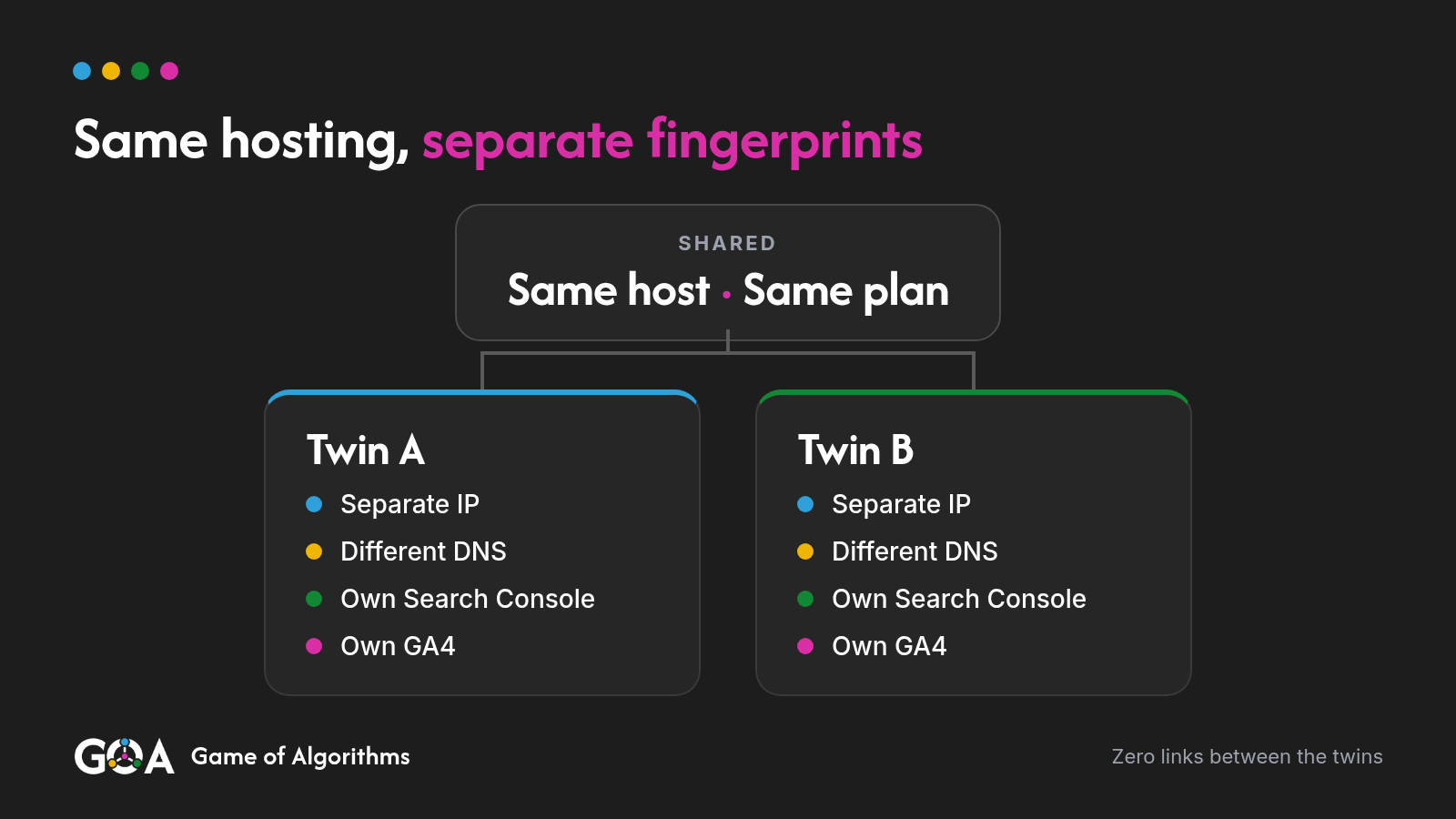
Back to the houses: same builder, same plans, different streets, different mailboxes. They’re twins. They just don’t get each other’s mail.
What I turned down, or the plans that got cut in the briefing
I rejected three setups that would have been easier but would have weakened the test.
- Two different hosts. Easy way to look “separate,” but it brings back the speed problem.
- One server, one IP. Perfectly equal, but the sites look like a pair.
- Cross-linking the twins “just a little.” No. A link passes authority and traffic, and that’s exactly the kind of leak that ruins a control. “Just a little” is how every heist movie goes wrong in the second act.
The trade-offs I’m still watching, because no plan is perfect
No hosting setup is perfect, so here are the trade-offs I’m tracking.
Server location can nudge speed. Different locations can mean slightly different load times depending on where a visitor is. I’m measuring speed on both twins so any gap shows up in the data instead of hiding in it.
The DNS split isn’t perfectly symmetric. A third-party DNS service and a registrar’s DNS can answer at slightly different speeds. That happens once, before the page even starts loading, so I expect it to be tiny. I’m still logging it, because tiny is what everyone says right before it isn’t.
The coin flip is my safety net. I don’t get to pick which twin gets the engagement. If one site has a small edge I missed, I didn’t hand it the treatment on purpose. And the baseline, both sites measured with no treatment for four to six weeks, shows how they behave before anything changes.
The takeaway if you’re running your own SEO test
Hold constant anything that could cause the result on its own, and separate anything that could tie your test subjects together.
Constant: speed, templates, content depth. Separate: IPs, DNS, analytics, links. Then let a coin pick who gets the treatment.
It’s not glamorous. Neither is building two houses nobody is allowed to visit yet. But it’s the difference between “I think engagement helped” and actually knowing.
Curious how fast Google found these houses once the doors opened? I timed it in a quick test.
Experiment 001 is in its baseline phase right now. If you want the result when it’s in, whichever way it goes, join the list.
No spam. No sales. Just useful, actionable content.
FAQ
Does sharing an IP address hurt SEO?
Not on its own. Plenty of normal sites share IPs on regular hosting, and Google has said that’s fine. I gave my twin test sites separate IPs anyway, not to dodge a penalty, but so nothing ties them together and muddies the experiment.
Get the next result first
One short email when a test finishes, with the real numbers, even when the answer is “nothing happened.”