For marketers, founders and newsletter writers who are tired of email advice that sounds confident and cites nothing. We put seven popular open rate myths on trial and give each one a verdict, with the evidence linked.
Before I call the first witness, I have to admit something about the evidence. The open rate, the number every one of these myths promises to raise, stopped being reliable in 2021. That is when Apple launched Mail Privacy Protection (MPP), and since then a big share of “opens” have been logged by software, not people. So the myth under all the myths is the scoreboard itself.
The myth under all the myths is the scoreboard itself.
One more note for the court record: GOA is a lab, and we don’t have our own email list data yet. Every verdict below is judged on other people’s published data, named and linked. No invented numbers, no secret studies, no “trust me, bro.”
Court is in session.
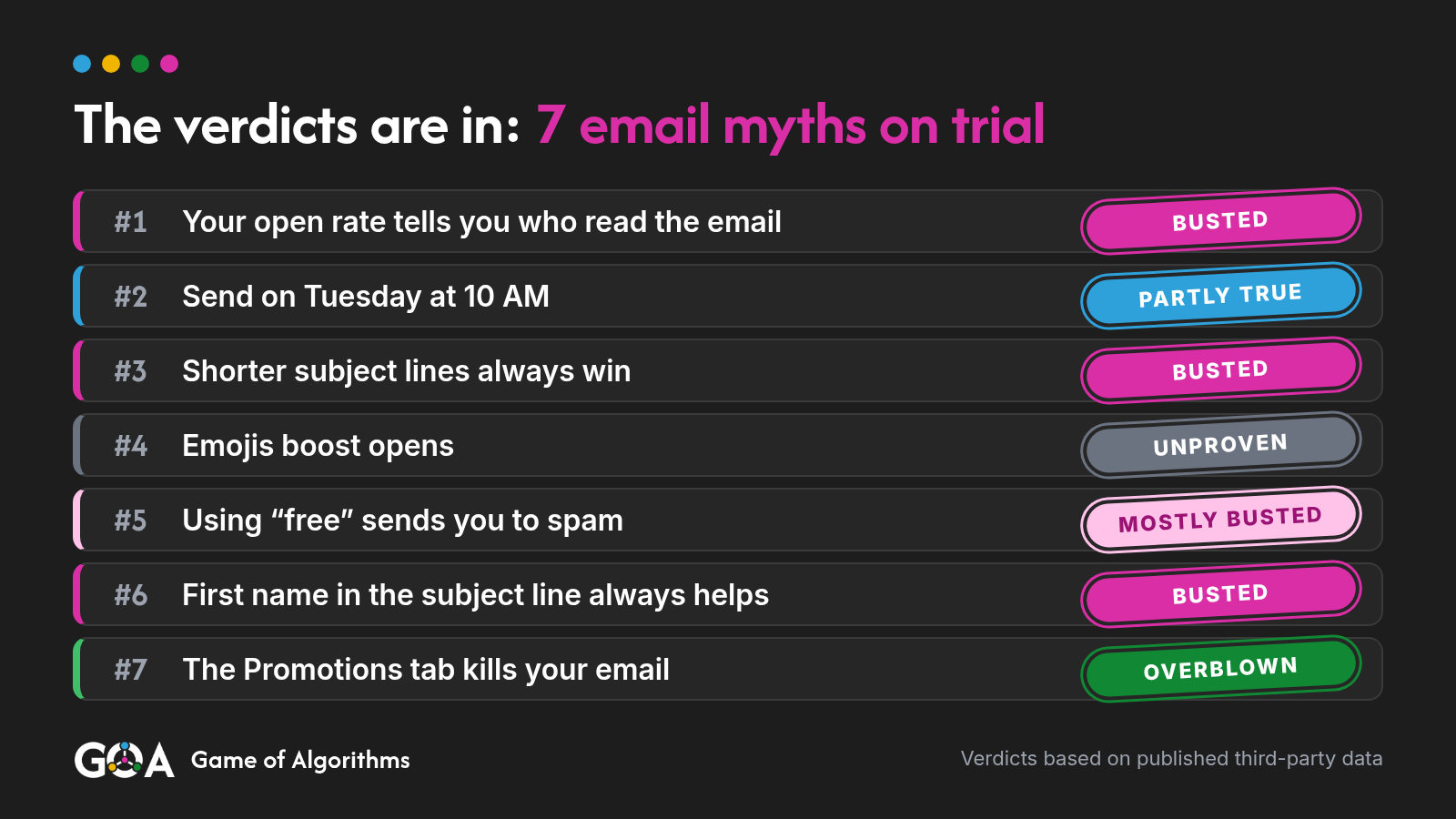
Myth #1: “Your open rate tells you who read the email”
Verdict: Busted
The myth is that your open rate shows who read your email, and it is busted, because Apple Mail Privacy Protection records opens whether or not anyone reads the message.
Since MPP launched in 2021, Apple Mail preloads emails and fires the tracking pixel on its own. The pixel is now a witness that testifies whether or not it saw anything. Litmus reported that MPP-affected Apple opens passed 50% by May 2022.
- 50%+of Apple opens affected by MPP (Litmus, May 2022)
- 2021the year Apple launched Mail Privacy Protection
What to do with that: treat opens as a rough trend line, not a headcount. Clicks, replies and purchases are much harder for a machine to fake.
Myth #2: “Send on Tuesday at 10 AM”
Verdict: Partly true
The myth is that Tuesday at 10 AM is the best time to send marketing email, and it is partly true: it describes an average, not a rule for your list.
Mailchimp’s send-time data puts the system-wide peak at 10 AM midweek, and Mailchimp itself says the best time depends on your audience. Seventh Sense, a company that sells send-time optimization (so weigh that accordingly), found only about 5 points of open rate between the best and worst day. Timing sends to each individual person made a much bigger difference.
Tuesday at 10 AM isn’t wrong. It’s just everyone’s answer, which means your email shows up in a very crowded hallway. Your subscribers are not the average of everyone’s subscribers.
Myth #3: “Shorter subject lines always win”
Verdict: Busted
The myth is that shorter subject lines always get more opens, and it is busted: a large study found essentially no link between subject line length and read rate.
In 2015, Return Path studied 9.3 million subject lines and found length barely mattered. Length was arrested on circumstantial evidence.
What does matter is where you put the point. Phones cut subject lines off, so if the interesting part lives at word eleven, most people never see it. Lead with the hook, then say whatever else you need to say.
Myth #4: “Emojis boost opens”
Verdict: Unproven
The myth is that emojis in subject lines increase open rates, and it is unproven: the published evidence is mixed.
Nielsen Norman Group found emojis didn’t make people more likely to choose an email to open. Phrasee ran a large controlled test and called its own result “inconclusive”: the emoji version won about 60% of the time and lost about 40%.
- 60%emoji version won (Phrasee)
- 40%emoji version lost (Phrasee)
- InconclusivePhrasee’s own verdict
A 60/40 split is a coin with a slight limp. If your brand likes emojis, go ahead and test them. Just don’t expect a little rocket ship to rescue a weak subject line.
Myth #5: “Using ‘free’ sends you to spam”
Verdict: Mostly busted
The myth is that using the word “free” in an email sends it to spam, and it is mostly busted: modern filters weigh sender reputation, authentication and complaints far more than individual words.
Mailchimp’s guide to spam filters says an email usually needs several red flags to get filtered, and that sending a big campaign from a brand-new domain is risky.
In 2021, Litmus argued that spam words only matter once your sender reputation is already bad. As reported by Litmus, Gmail’s anti-spam team’s point was about engagement: make people love your emails.
Why “mostly”? Because red flags add up. One “free” is a word. ALL CAPS plus “FREE!!! Act now” is less a word choice and more a confession.
Myth #6: “Putting their first name in the subject line always helps”
Verdict: Busted
The myth is that adding a subscriber’s first name to the subject line always raises open rates, and it is busted: a 2023 study tried to repeat that result and couldn’t.
A peer-reviewed field experiment published in Marketing Letters in 2023 retested the classic first-name finding. Open rates were actually slightly lower with the first name, though the difference wasn’t statistically significant.
“Hey {FirstName}” had a good run. The court thanks it for its service. And if your merge field ever breaks, “Hey ,” certainly isn’t helping.
Myth #7: “The Promotions tab kills your email”
Verdict: Overblown (but the data is old)
The myth is that landing in Gmail’s Promotions tab kills your email results, and it is overblown, though the best evidence on it is old.
A 2013 Return Path study of the tabbed inbox found most commercial mail landed in Promotions, with read rates roughly in line with what they were before tabs existed. That study predates Apple MPP, so treat it as an old exhibit, not fresh testimony.
My read: a tab isn’t a jail cell. Spending your energy fighting your way out of Promotions usually pays less than the boring stuff in the next section.
What actually matters: getting delivered first
An email can’t be opened if it never reaches the inbox, so deliverability comes before every subject line trick above.
Since February 2024, Gmail requires bulk senders, meaning anyone sending 5,000 or more emails a day to Gmail addresses, to do three things:
- 5,000+emails a day to Gmail makes you a bulk sender (Gmail, since Feb 2024)
- 0.3%spam complaint limit, target under 0.1% (Gmail, 2024)
- 48 hrsto honor an unsubscribe (Gmail, 2024)
- Authenticate your mail with SPF, DKIM and DMARC. In plain words: SPF is a public list of the servers allowed to send email for your domain. DKIM is a digital signature that proves the message really came from your domain and wasn’t changed along the way. DMARC tells inboxes what to do when a message fails those checks, and sends you reports about it.
- Make unsubscribing easy. Offer one-click unsubscribe and honor unsubscribe requests within 48 hours.
- Keep spam complaints low. Stay under a 0.3% spam complaint rate, with a target of under 0.1%.
Yahoo has matching rules for bulk senders. If you send fewer than 5,000 a day, not every bulk-sender rule applies to you, but it’s still the right baseline. Get these right and most of the myths above become small tweaks instead of life-or-death decisions.
FAQ
What is a good email open rate after Apple MPP?
There isn’t a clean benchmark anymore, because MPP records opens whether or not someone reads the email. Litmus reported MPP-affected Apple opens passed 50% by May 2022. Compare your own open rate to itself over time, and lean on clicks and replies for the real story.
Do emojis in subject lines increase open rates?
The evidence is mixed. Nielsen Norman Group found emojis didn’t make people more likely to choose an email, and Phrasee called its own large test inconclusive, with the emoji version winning about 60% of the time and losing about 40%.
What is the best time to send marketing emails?
Mailchimp’s data puts the system-wide peak at 10 AM midweek, but Mailchimp says the best time depends on your audience. Seventh Sense found per-person timing mattered much more than the day of the week.
The court is adjourned (for now)
Every verdict here rests on someone else’s data. That’s fine for a first trial, but a lab wants its own evidence. We’ll test the ones we can once our own list is big enough, and we’ll publish whatever we find, including the boring results.
Want a seat in the jury box? Join the GOA list to see the results.
Get the next result first
One short email when a test finishes, with the real numbers, even when the answer is “nothing happened.”