
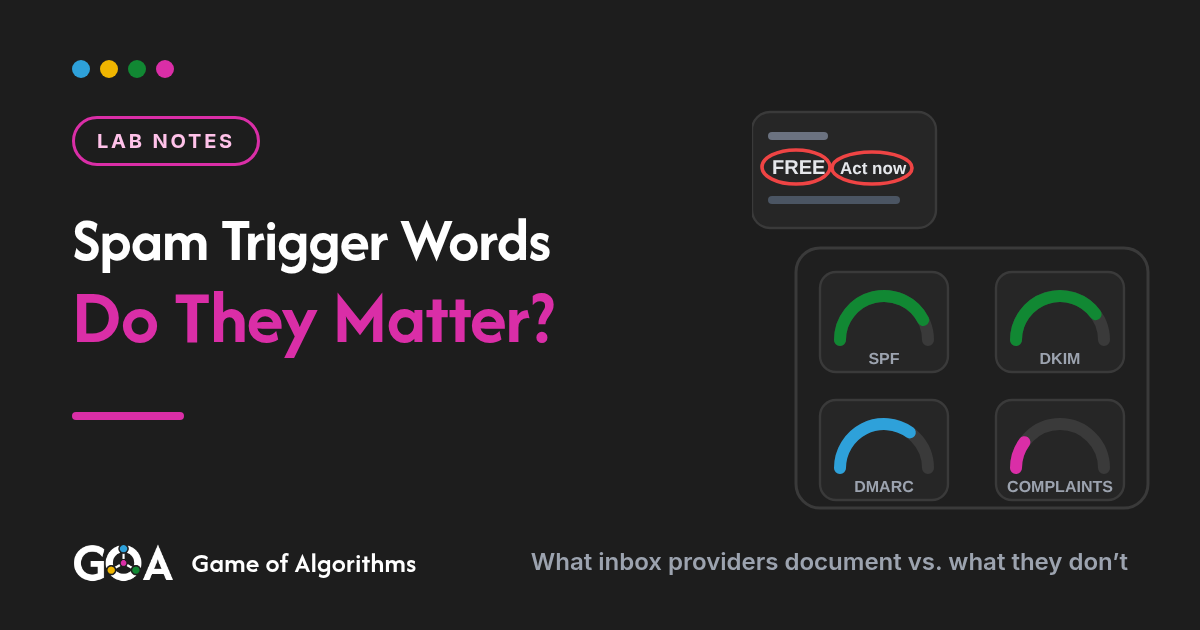
There’s a whole corner of the internet that treats certain words like contraband. Type “free,” “act now,” or “payday loans” and the spam filters will personally escort your email to the junk folder. Some of these lists run to hundreds of words.
I wanted to know what’s actually written down by the people who run the filters. So I went through what Gmail, Yahoo, Microsoft, SpamAssassin, the FTC, and Kit have published, and kept it separate from the rumors and secondhand advice.
If you’re specifically wondering about the word “free,” I already covered that in 7 Email Open Rate Myths (Myth #5).
What the big mailbox providers actually say
Gmail doesn’t have a word list
Documented
Their sender guidelines talk about authentication, spam rates, formatting, and unsubscribes. No banned words. What they do care about is honesty: headers and content shouldn’t be misleading. They also specifically call out fake “Re:” or “Fwd:” subject lines and using HTML/CSS to hide text.
Urgency in the display name is the real problem
Documented
The closest Gmail gets to a phrase list is their display-name advice. They list examples to avoid: “TIME IS RUNNING OUT (SALE),” “URGENT REQUEST,” “Last Chance.” The rule is that your display name should identify you, not act like a second subject line. It’s the placement that bothers them, not the words.
Yahoo and Outlook are focused on the basics
Documented
Yahoo wants authentication, a spam rate under 0.3%, valid DNS, and easy unsubscribes. Microsoft’s 2025 Outlook requirements (for domains sending 5,000+ a day to Outlook.com addresses) require SPF, DKIM, and DMARC. Both say to use accurate subject lines and avoid deceptive headers. Neither mentions trigger words.
The one place the idea has a real basis
Documented
SpamAssassin (an open-source filter some people still run) does score certain phrases. Its old rule list includes things like:
- ACT_NOW_CAPS (“acting now” in all caps)
- FREE_QUOTE_INSTANT
- MONEY_BACK
- GUARANTEED_100_PERCENT
- BAD_CREDIT
It also catches people trying to sneak past it with “F R E E” or similar tricks. These rules usually add a fraction of a point to a couple of points. The default spam threshold is 5 (and many admins raise it higher).
SpamAssassin itself says single-word rules are weak because they ignore context. I didn’t find a rule for the bare word “free” in the body, or for “payday loans” or “make money online.”
What the law actually cares about
Documented
CAN-SPAM says don’t use deceptive subject lines. The subject has to reflect what’s in the email. Penalties can be steep, but the rule is about honesty, not about any specific word being banned.
What everyone else says
Secondhand
Kit (the email platform) says content matters less than it used to for inbox placement, though it can still matter if your reputation is weak. Their advice on wording is basically “don’t sound overly salesy or urgent.” Their spam checklist doesn’t mention word choice.
The common claims, ranked
- Not supported “Using a spam word lands you in spam” — Not supported by anything Gmail, Yahoo, or Microsoft publish. Even in SpamAssassin the phrases are just a few points among many other factors.
- No “There’s a master list the filters share” — No. The big providers don’t publish one.
- Partly true “Content still matters for some senders” — Partly true. Kit and SpamAssassin both say content can matter more when reputation is weak. Neither says one word decides it.
Quick version
- SpamAssassin scores some phrases and obfuscation tricks.
- Gmail, Yahoo, and Outlook do not publish trigger-word lists.
- Deceptive subject lines and fake urgency in display names are actual problems (documented + legal).
What I think is going on
Inference
Those giant word lists stick around because a lot of spam really does say “act now” and “100% guaranteed.” Filters that learn from spam pick up the patterns. A pattern isn’t a ban. The documented signals are still authentication, complaint rates, consent, and not being deceptive.
Avoiding pure hype language might help for a simpler reason: fewer people hit “report spam.” That improves the complaint rate the providers actually track. It’s not about dodging a secret word filter.
My take
I wouldn’t run every email through a 200-word scrubber. The providers who matter most don’t publish lists like that, and the filter that does score phrases treats them as one small signal among reputation, blocklists, and authentication.
If your basics are solid (you’re authenticated, people asked to hear from you, and you’re not lying in the subject line), “free” is a small detail. If the basics are broken, deleting “free” won’t save you.
FAQ
Are spam trigger words real?
Partly. SpamAssassin scores some phrases. The major mailbox providers do not publish lists.
Will “free” send me to spam?
Not by itself, based on what’s documented. See the earlier myths post for the longer version.
What actually matters more?
Authentication, low complaint rates, real opt-in, list hygiene, gradual volume ramps, and accurate headers.
Is “urgent” illegal?
No. Misleading people is the problem. A subject line that doesn’t match the email is what CAN-SPAM cares about.
Should I write “F R E E” to slip past filters?
No. SpamAssassin has rules for that, and Gmail warns against hiding content.
If you want more of these notes when they come out, join the list. One short email when something finishes, with the actual numbers — even when the answer is “nothing happened.”
Sources
- Gmail Help, “Email sender guidelines”: https://support.google.com/a/answer/81126
- Yahoo Sender Hub, “Sender Best Practices” (Sender Requirements & Recommendations): https://senders.yahooinc.com/best-practices/
- Microsoft Community Hub, “Strengthening Email Ecosystem: Outlook’s New Requirements for High-Volume Senders” (Apr 2, 2025, with Apr 29 update): https://techcommunity.microsoft.com/blog/microsoftdefenderforoffice365blog/strengthening-email-ecosystem-outlook%E2%80%99s-new-requirements-for-high%E2%80%90volume-senders/4399730
- FTC, “CAN-SPAM Act: A Compliance Guide for Business”: https://www.ftc.gov/business-guidance/resources/can-spam-act-compliance-guide-business
- Apache SpamAssassin, “Tests Performed: v3.3.x” (archived rule list with default scores): https://spamassassin.apache.org/old/tests_3_3_x.html
- Apache SpamAssassin, Mail::SpamAssassin::Conf documentation (4.0.x,
required_score): https://spamassassin.apache.org/full/4.0.x/doc/Mail_SpamAssassin_Conf.html - Apache SpamAssassin Wiki, “WritingRules”: https://cwiki.apache.org/confluence/display/SPAMASSASSIN/WritingRules
- Kit Help Center, “Deliverability 101” (Jun 25, 2026): https://help.kit.com/en/articles/3172555-deliverability-101
- Kit Help Center, “Why are my emails going to spam?” (Aug 5, 2026): https://help.kit.com/en/articles/3372365-why-are-my-emails-going-to-spam
- Game of Algorithms, “Top 7 Myths on Getting Your Marketing Emails Opened”: https://gameofalgorithms.com/myth-trials/email-open-rate-myths/
Notes on verification: I read the text of every source directly. The Microsoft post’s original text says non-compliant mail goes to Junk first; its April 29 update changes that to rejection from May 5, 2025, though one leftover paragraph still mentions Junk. The SpamAssassin rule list is an archived page for version 3.3.x. Current installs get rules through updates, and admins can change scores, so treat those scores as illustrative. My statement that no rule targets the bare word “free,” “payday loans” or “make money online” is based on the rule names and descriptions in that list, not on reading every regex. Kit is an email platform, so its guidance is labeled secondhand. The rumors in this post are attributed generically because I didn’t verify a specific source for them.
Get the next result first
One short email when a test finishes, with the real numbers, even when the answer is “nothing happened.”